LINDEN SHOWALTER ACHIEVES ULTRAMARATHON MILESTONE IN 2025 JFK 50 MILE
By Robb Helfrick
Three days before the JFK 50 Mile race in Washington County, Maryland, scheduled for November 22, Linden Showalter discussed his outlook to complete the race for the 9th time. “I’ve never attempted this with the level of uncertainty I have this year.”
This edition of the JFK presented two unique challenges for Showalter. The most important aspect was achieving a longevity milestone by completing the race 50 years after his first successful finish in 1975. Only two competitors in the event’s storied history had ever accomplished that feat.
The second challenge was reaching that goal despite wrestling with a nagging injury that had plagued Showalter for the past year. As race day approached, Linden was uncertain how the latter challenge would influence his quest to achieve top-three all-time JFK durability.
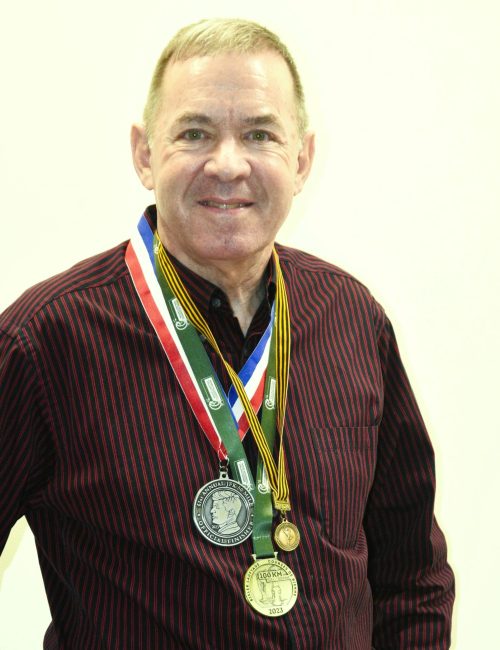
As a finisher in all three of the world’s most prestigious ultramarathons, Showalter, 66, felt confident about his mental approach. The JFK 50 takes a toll on both mind and body. Going into the race, Linden’s psychological focus was as sharp as ever. “I’m mentally prepared for it,” Showalter said.
However, while battling plantar fasciitis for over a year, Showalter had to alter his training. He prepared for the JFK only by walking to help rest his affected foot. Meanwhile, he tried multiple remedies to heal the injury. “I have a list of 25 things I’ve tried.” Some of those treatment combinations eased his discomfort, but none completely cured the ailment to date.
On Wednesday of race week, Showalter was plain-spoken about his chances. “There’s always some pre-race jitters, but with this injury, the end result is not completely in my control.”
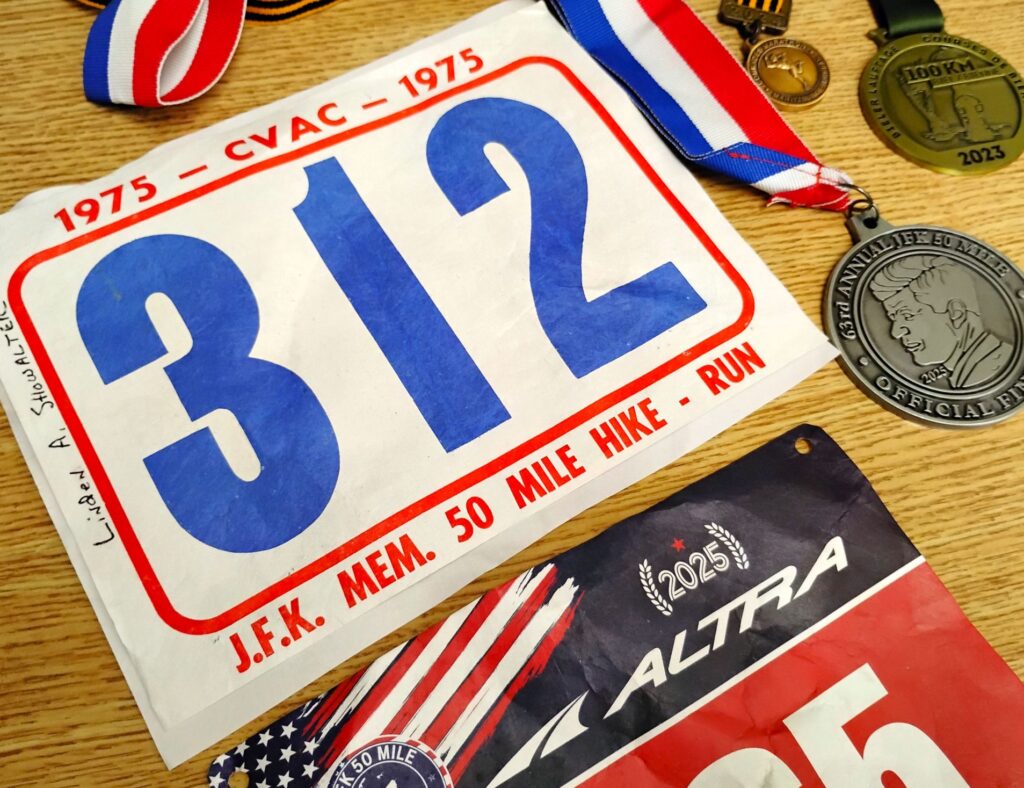
Despite lingering doubt, Showalter planned for the optimum scenario by executing meticulous pre-race preparation. This included consistent training, despite his injury, with the longest workout being a 27-mile walk. His 2025 plan was to speed-walk the entire course (clocking 13-minute miles); in the past, he’d run two-thirds of the JFK course.
As race day approached, no details were ignored, including the Maryland weather forecast, which is always unpredictable in late November. Luckily, that crucial aspect looked promising, with predicted temperatures in the low 50s, no wind, and only a slight chance of rain. “Can’t beat that forecast,” Showalter said.
Linden lined up his support team, which included a friend, plus Showalter’s wife and son. He planned to host a few running buddies on Thursday evening. “We’ll tell stories and make race plans.” Then, Linden would take a half-day off work on Friday and get to bed early. “I’ve done all I can do to get ready,” Linden said three days before the race.
Despite all that preparation, Showalter was honest about his race outlook. “I don’t know how it’s going to go.” Still, the veteran ultramarathoner had finished the race in 8 of 9 attempts and also completed other challenging long-distance running events over several decades.
During the race, Showalter planned to monitor his injured foot as the JFK 50 progressed step by painstaking step. “I know how to read my body so I don’t go beyond my limits and further injure myself.”
Then, Linden Showalter smiled. “I’m also very competitive and driven.” The only thing certain at 6:30 am on race day for this athlete: “I’ll be on the starting line.”

Saturday dawned with thick fog in Boonsboro as 1208 competitors lined up for the 50-mile challenge. The first three miles of the JFK are run on hard roads, but the course gains 1000 feet in elevation as it climbs South Mountain. Then, the next 13 miles follow the Appalachian Trail, a narrow and rocky footpath.
It had rained the night before, so the rocks and roots that dotted the trail were slippery. Rain had packed down the fallen leaves, but the mud was treacherous. “You have to keep your eyes focused on the next step,” Linden said. “If you look around to enjoy the scenery, you’ll trip and go down.” After finishing the Appalachian Trail section, Showalter recalled thinking: “I don’t want to see another rock in my life.”
After the JFK course left the AT after a steep descent at Weverton Cliffs, Showalter met his support team for the first time (the race provides most support with aid stations all along the route) and was on target with his planned strategy. As a CPA, mastering numbers is a natural skill for Showalter. During the JFK, he constantly calculated race splits in his head.
The next section of the course provided more of a mental than a physical challenge to the race participants. The C&O Canal towpath is flat and provides a comfortable running surface. However, this 26-mile stretch along the Potomac River provides the same monotonous (although scenic) view for more than half the race.
But Showalter enjoys the towpath and has trained there many times. “I think it’s beautiful.” To help with the long stretch, he only concentrates on each successive 4-mile segment. On race day, he constantly evaluated his injured foot. “I wasn’t feeling any more discomfort than in the past month. It was manageable.”
At mile 27, Showalter’s son, Austin, was there to greet him and provide support at the Antietam Aqueduct checkpoint. “It was so good to see a familiar face,” Linden said. After a quick change of shoes, Showalter was off again. He was still ahead of his projected pace.
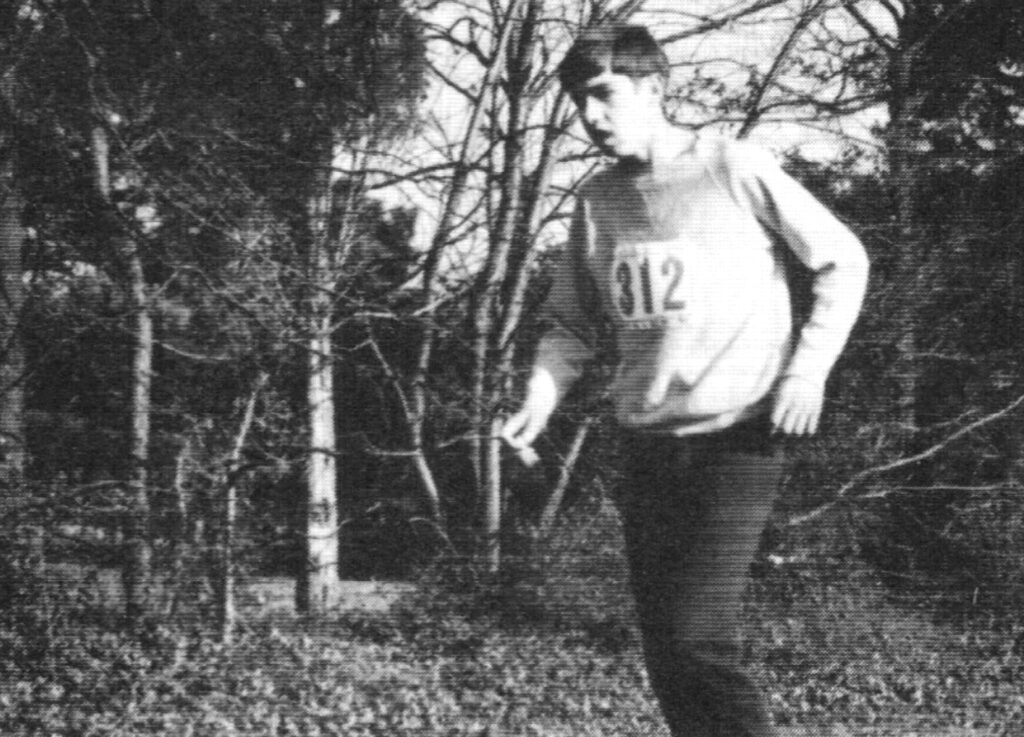
A few miles later, Showalter passed a mental checkpoint; the Shepherdstown Bridge spanning the Potomac. He got emotional as he described that landmark at mile 30. Memories from an unsuccessful JFK race 51 years earlier resurfaced when Linden said, “Now I’ve passed the place where I dropped out as a 15-year-old.”
With 20 miles to go, Showalter stuck to his pace and his mental exercises, saying, “I was telling myself I don’t have to run 20 miles, I have to run 4.” During this stretch he had few conversations with other competitors, since the runners ran faster, and when they slowed to a walk, Showalter was moving past them with his speed walking.
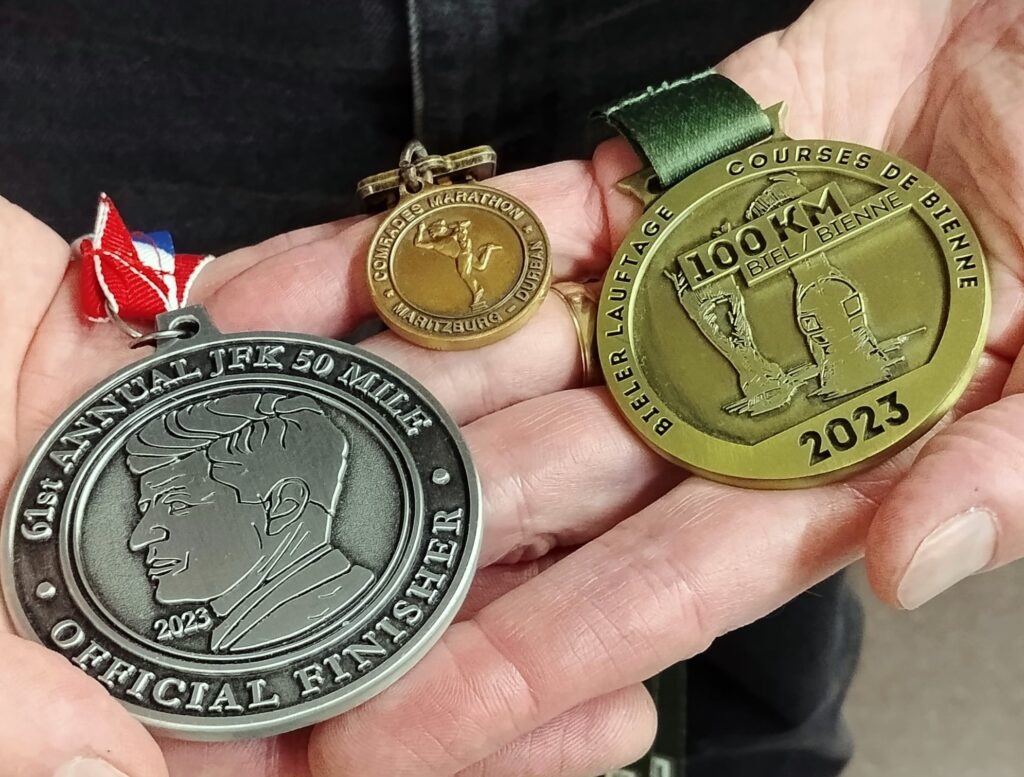
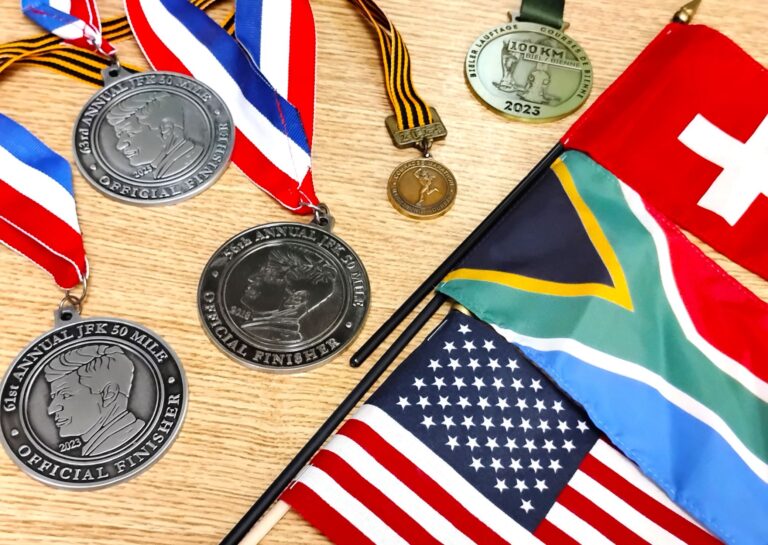
Along the towpath, a few runners recognized the Comrades Marathon shirt that Linden wore and understood the significance of the famous ultramarathon (a 55-mile race) that Showalter had earlier finished in South Africa.
As he progressed toward the end of the towpath section, Showalter described his mindset. “I felt pretty good the whole way. But in the back of my mind, I’m wondering if the injury flares up, how will I handle that?”
Fortunately, that concern never materialized. Linden’s wife, Ruthie, took over as his support team for the JFK’s last stages, which provided another boost.


After Showalter left the towpath at mile 42, his mood was upbeat, and his outlook was confident. “I’m going to get this done.” Climbing a steep hill got him back on local roads leading to the finish eight miles distant.
On this final stretch, race organizers marked every milepost. But the signs indicated not the distance the competitors had traveled, but how far they had to go. “At that point, I got excited,” Linden said. “I didn’t have much to worry about; I just needed to finish.”
While planning for the race, with a goal of completing the course in 12 hours (the cutoff for finishers is 13), Showalter knew if he finished, it would be after dark. This was another factor he typically avoided in earlier JFK’s, since he normally completed the race in 9 ½ hours.
For competitors on pace to finish after sundown, the race provides a reflective safety vest for those last few miles on public roads. Linden slipped on his vest and kept his steady pace.
As Showalter’s race entered the final stages, he told himself it was acceptable to decrease his pace. But his body and mind were locked into his rehearsed gait, and he couldn’t slow down. “I had one gear and was stuck in that gear.” Those last 8 miles would be his fastest section of the JFK.
The sun hung low over the horizon as Showalter approached Downsville. Aid stations were more plentiful during this stretch, but Showalter had a troubling experience. “I started to feel dizzy. I was okay as long as I kept moving.” When he stopped at aid stations, he had to hang on to a table with both hands, afraid he might fall.
However, after resuming the course, Showalter kept up his planned pace of 12-13 minute miles as the sky grew dark and he made the last turn toward the finish in Williamsport.
Like prior years, the last few miles were a blur for Linden. “I wanted to stop moving and get to the finish line.” With his sense of balance compromised, he was trying to hold his mind and body together, and it took a concentrated effort to finish. “I just kept moving and didn’t change my pace.”
Traveling the final mile uphill, Showalter was buoyed by cheering people and hearing the live broadcast at the finish. After 11 hours, 14 minutes, and 18 seconds on the move, Linden Showalter achieved his hard-earned goal. He completed the JFK 50 Mile for the 9th time. A half-century of living had passed between his first completed race and this year’s successful finish. After months of planning, training, and fighting injury, he had achieved a feat most people could never contemplate.
At age 66, Linden Showalter traveled 50 miles on foot in under half a day, finishing with a consistent pace of 13:26 per mile. “I was so pleased to accomplish this,” Showalter said, and added his time was nearly an hour faster than anticipated. Linden also remarked that 99% of the JFK race finishers were younger than him. Being modest, he didn’t mention that he finished ahead of 378 fellow competitors.
Showalter’s wife, Ruthie, greeted him at the end and noticed Linden’s posture was leaning heavily to one side as he crossed the finish line. But after Showalter rested a few minutes in a chair, he regained his equilibrium and went inside the gymnasium for a much-needed post-race massage.
Asked if he remembered how he felt 50 years earlier after finishing, he said, “I was more exhausted when I was 16. A younger person is stronger and faster but lacks the endurance of an older person. We lose our speed and strength as we age, but I feel I have better endurance now.”
Another Showalter was in the JFK field this year. Linden’s sister, Carolyn, 71, finished an hour later in 12:35:52 to win her Super Senior (over 70) age group. She was also the race’s most senior finisher. Carolyn Showalter has developed an outstanding JFK pedigree over several decades, with 6 women’s overall championships. “She really shines in this event,” Linden said.
Carolyn’s and Linden’s brother, Lowell, has also completed many JFK races. Linden’s son, Grantley, has finished the race too (and also completed a 60-day cross-country cycling trip), and the family boasts an amazing 70 combined JFK 50 Mile finishes. These Showalter stories are athletic feats that require a full accounting on their own merit.
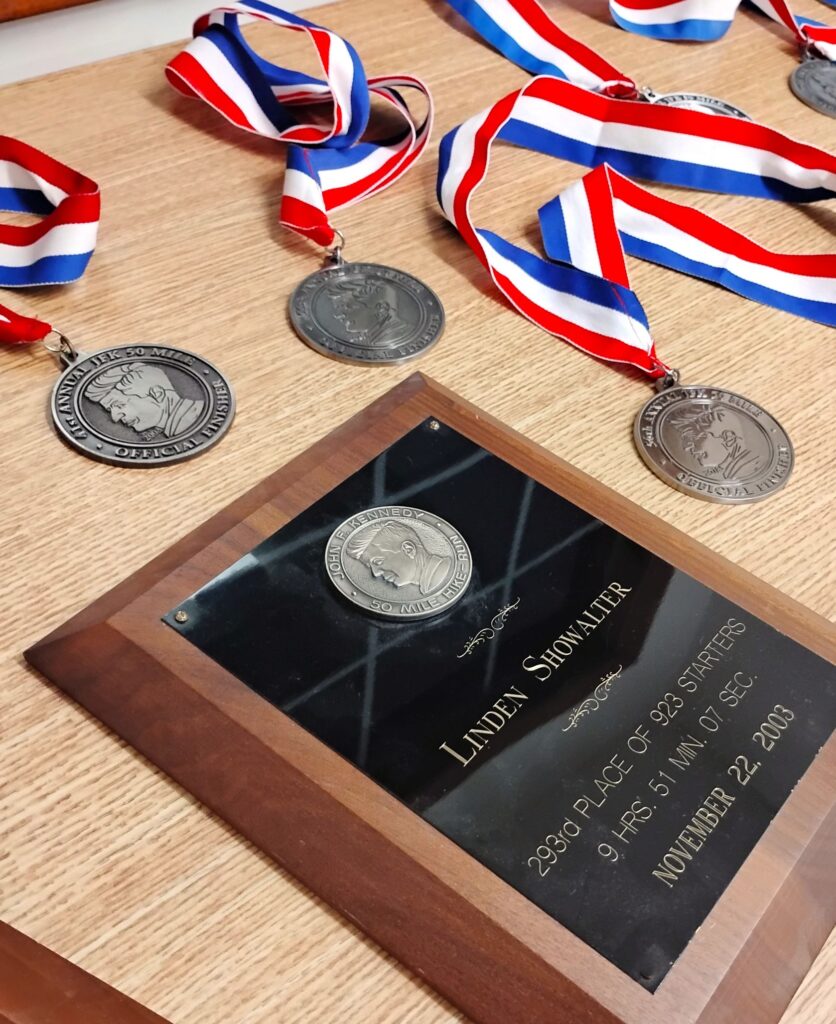
A few days after the JFK, Linden Showalter was rested and relaxed. He recounted the race in his office, surrounded by an assortment of medals and international running mementos. He smiled and said, “I’m glad it’s over, but also happy I did it.”
Thinking about the future, Linden said if his physical condition remained the same or it hopefully improved by next year, he would likely sign up for another JFK 50 Mile on March 1, the day entries open for 2026. “Absolutely, I’d do it again.”
Although Showalter admitted that completing a 10th JFK in 2026 would be an achievable goal, he said he would make future race decisions based on his physical comfort. He has already proved himself as a formidable athlete, both in body and mind. “This race was a big milestone for me. Even if there isn’t another one, what a way to finish.”