“EYES IN THE DARK”: A CIVIL WAR HEROINE IS REMEMBERED AT MONTEREY PASS
By Robb Helfrick
During the American Civil War, most northern locales escaped the horrors of warfare that bloodied fields and demolished towns throughout the Confederacy. However, one exception to the Union’s territorial safety was Pennsylvania. Two of the state’s southern counties witnessed two disastrous episodes during 1863. In June and July, Adams and Franklin Counties experienced firsthand terror when their civilians found themselves trapped in the tempest of a tumultuous war.
General Robert E. Lee commanded the Army of Northern Virginia across the Mason-Dixon Line in late June 1863. His goal: to lead his men as far north as possible into enemy territory, create havoc, and force the Union government to negotiate for peace. But Lee never reached Harrisburg or Philadelphia. He and his 70,000 soldiers were drawn into a major battle at Gettysburg.
That fight produced gruesome results, with approximately 50,000 casualties. Gettysburg’s symbolic and strategic location made it one of the most epic battles in history. During the three-day clash, the town was caught in the crossfire, and Gettysburg’s inhabitants lived in constant peril. A twenty-year-old woman named Jennie Wade was killed in her kitchen when a stray bullet penetrated her home on Baltimore Street.
At the battle’s pivotal moment, General Lee made a tactical error. His army had previously fought and won with inferior numbers and bold tactics, but at Gettysburg, rebel soldiers could not take the Union high ground that Lee desperately wanted. Confederate troops were repulsed and decimated. General Meade’s Yankee soldiers emerged victorious, and a stunned Lee had only one remaining option: retreat.
Escaping with a massive and wounded army was a tremendous logistical challenge. Lee split his remaining 50,000 men into two columns. His intent: to reach Williamsport, Maryland, and then cross the Potomac River into safe territory. These wagon trains reached over twenty miles in length. It was an impossible task to hide the movement of that much material and men. One local said those wagons rumbled by his home for several days with no break between them.
One chosen Confederate escape route was through Fairfield Gap and then up over the Appalachians at Monterey Pass. The road was easily navigable during fair weather. On July 4, 1863, a snaking Confederate column traveled toward the pass. A young local woman noticed.
Her name was Henrietta Zeilinger, a seventeen-year-old who lived on a farm near the summit. Unlike most local residents, who withdrew from the invaders, ‘Hetty’ kept her eyes fixed on the rebels. As the weather worsened and torrents of rain fell, the mountain road turned into a quagmire.
Union soldiers appeared next, under the command of General Kilpatrick. They chased the rebels, trying to disrupt their retreat. Hetty met them with a warning. The Confederates were positioned ahead with a cannon pointed toward the Yankees.
The chaotic and confused fighting at Monterey Pass took place after midnight in a raging thunderstorm. In total darkness during torrential rain, only flashes of lightning or a gun’s blast offered enough illumination to spot the enemy. Despite these dangerous conditions, a soldier hoisted a fearless Hetty Zeilinger onto his saddle, and she helped guide the Union army.
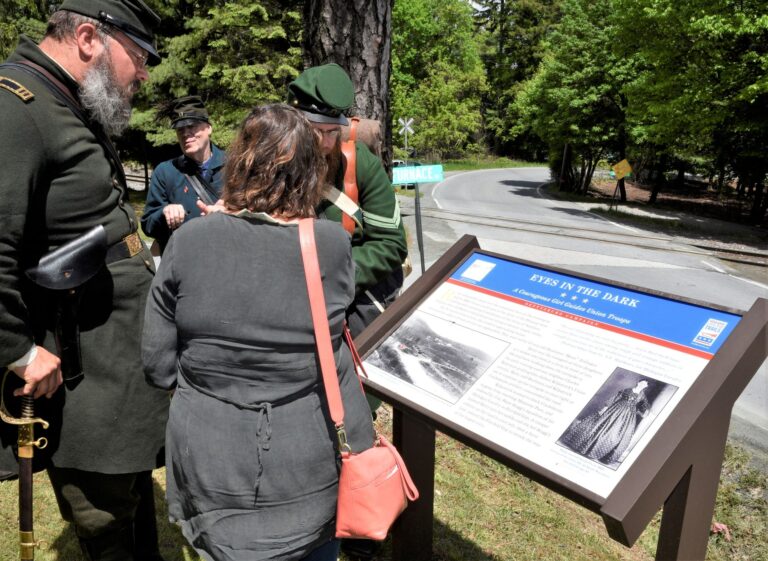
In 2024, 161 years later, Hetty’s bravery was honored at the dedication of a Civil War Trails commemorative sign, celebrating her moment of glory at Monterey Pass. The dedication took place at Charmain and Furnace Roads, a short distance from the battlefield. A group of local historians, Zeilinger descendants, and Civil War enthusiasts gathered to hear speeches and view the new sign, which stands in a peaceful grass triangle along the roadside. The title for the dedicated sign is “Eyes in the Dark.”
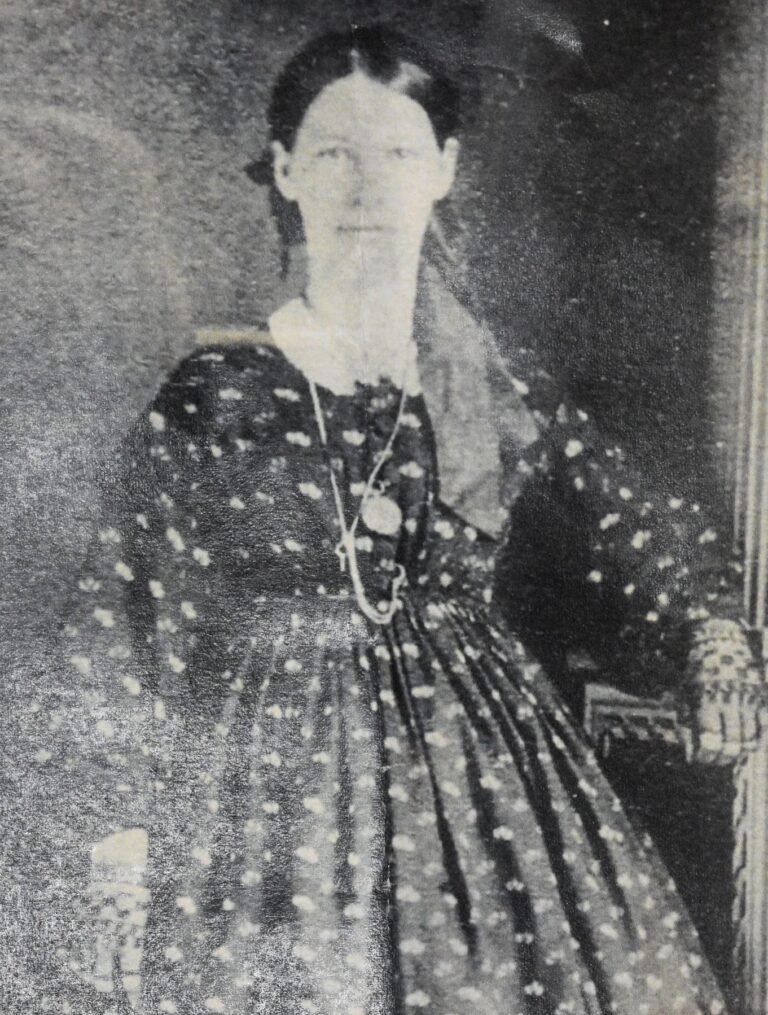
The only known portrait of Hetty Zeilinger graces this sign, and the image shows a proud young woman in period dress. Her portrait exhibits the aura of a young lady who met life’s challenges with calm confidence.
Lieutenant A.E. Mathews from the 1st Michigan Calvary remembered Hetty’s valor in a letter he later wrote to Zeilinger. “The act of guiding me and my party…down that dark lane, across the creeks, alone among rough and strange soldiers is enough to convince me of the nobleness of your character.”
After the battle, Miss Zeilinger married Jacob Fitz. Together, the Fitzs raised seven children, enjoyed 25 grandchildren, and had 25 great-grandchildren. Hetty Zeilinger-Fitz lived her entire life on South Mountain. She died on October 20, 1932, at age 87 and was buried nearby at Adams County’s Fountaindale Union Cemetery. Hetty’s weathered headstone stands upright with simple dignity.
At the conclusion of the 1863 Monterey Pass battle, General Lee and his long wagon columns survived Union harassment, reunited, and reached the Potomac. Swollen by heavy rain, the river was uncrossable for a spell, and the Army of Northern Virginia was temporarily trapped.
If General Meade’s aptly named Army of the Potomac had aggressively attacked the Confederates, he might have crushed his southern enemy on the river’s Maryland shore. But Lee eventually escaped into Virginia and regrouped to fight another day. One year later, his army returned to Franklin County. A general demanded a ransom from Chambersburg, and when his demand wasn’t met, the Confederates burned the town, leaving Chambersburg in ashes.
Today, the Friends of Monterey Pass Battlefield have preserved the historic 125-acre battleground near Blue Ridge Summit. The group sponsors various programs throughout the year, including a battle reenactment, cultural events, and it archives relics and interpretive information at an attractive museum. Well-marked trails allow visitors to explore the rugged terrain of a memorable Civil War battle that occurred on a stormy night, where a brave young woman served as the Union army’s eyes in the dark.