
NEW HOPE SHELTER LAUNCHES CAPITAL CAMPAIGN TO RAISE VITAL FUNDING FOR POTOMAC STREET BUILDING REPAIRS
By Robb Helfrick
Helping people in need is a never-ending endeavor for most charitable organizations. For Waynesboro’s New Hope Shelter, its ongoing mission is to literally put a roof over the heads of people facing a housing crisis. Now, that roof is in desperate need of repair. NHS recently announced a capital campaign to raise funds for vital repairs to its building at 25 South Potomac Street.
“I don’t think the roof will make it another winter,” Director Mandi Howell said in a recent interview. The organization has owned the building for 30 years, and while that has its advantages, that also means that NHS must pay for all upkeep and repairs. Howell was unsure when the roof was last replaced, and with it now leaking, they want to avoid further structural damage and fix it as soon as possible.
Since 1998, New Hope Shelter has provided temporary housing for the homeless in Franklin, Fulton, and Adams Counties here in Pennsylvania. The organization is a faith-based Christian non-profit that operates year-round and helps up to 150 individuals a year, nearly one-third of them children.
Funding this essential operation is a constant challenge, since New Hope runs entirely on donations, most of them private. The goal for this repair campaign is $350,000. “It’s a significant amount for us,” Howell said. “We want people to know this is happening. We are taking donations to fix the roof, the windows, and the kitchen floor.”
The roof repair will encompass about half of the fundraising goal and is the most critical aspect of the three-repair plan. The need to replace the building’s front windows is obvious to anyone who passes by the shelter, as those portals are boarded up. The kitchen will require new floor joists and other structural repairs.
Howell said that mailers have already been sent out to businesses and other organizations. Managing its non-stop fundraising for daily operations, along with raising money for these immediate repairs, is a delicate balancing act, one that the organization is prepared to pursue. The NHS has established a separate bank account for the repair work, and people and businesses can decide if they want their donations to go toward that immediate critical need. Howell mentioned that private fundraising is the key to a successful campaign. “It’s nearly impossible to find grant money for repairs.”
The shelter also plans to host events to supplement their fundraising efforts and will alert the public when those plans have been finalized. They hope to raise the necessary funds by this fall, so work can begin on the roof before winter arrives. The repairs for the roof, windows, and kitchen will require up to a four-month timeframe.
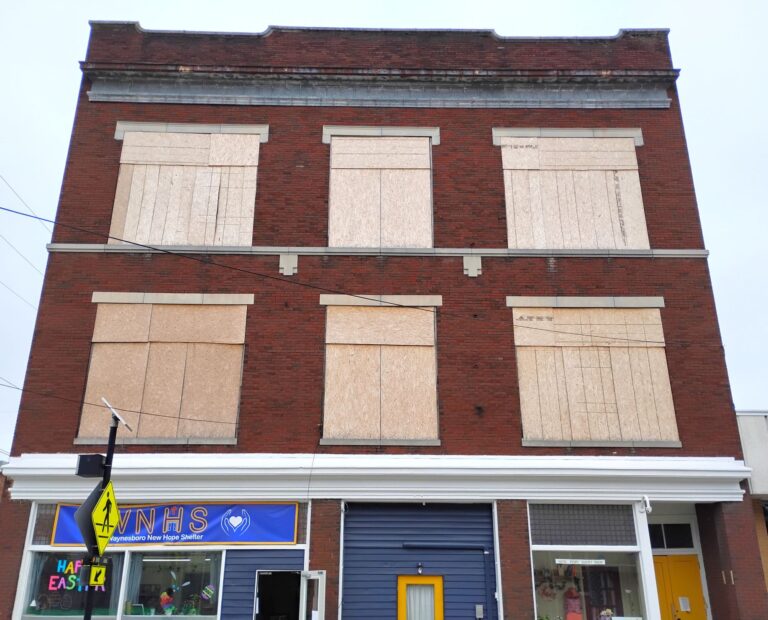
With that campaign already in motion, New Hope Shelter is planning for phase two of its 2026 fundraising goals. The organization envisions new practical uses for the unoccupied spaces on the second and third floors of its building.
New Hope’s goal is to build boardinghouse-style rooms on the second floor to ease the transition from the shelter to affordable housing. They hope to build efficiency-style apartments on the third floor. “We own the building, so we want to take advantage of what we have,” Howell said.
She mentioned that creating these spaces is more important now that wait times for rentals have dramatically increased for low-income individuals and families. “We used to have a six-month turnaround for people waiting on income-based housing. Now we’re seeing 18 months to two years,” Howell said. She mentioned that people already in place in those limited low-income local public housing units aren’t leaving, since they can’t afford rising market-based rental rates, causing a backlog for those trying to enter.
In addition to a shortage of affordable housing, low-income individuals struggle with the area’s lack of public transportation. Finding and keeping employment is much more difficult when people can’t commute to work.
All these challenges make Howell and her team determined to utilize their large downtown building to its fullest capacity. “We want to make it more affordable here, so people have a place to go as they transition to other housing. They face a lot of hurdles.”
Howell encourages the public to visit NHS’s website to learn more about the shelter and to explore donation options. NHS is the largest shelter in Franklin County, and is an important resource beyond Waynesboro’s borders.
New Hope also has a thrift store on the Rotary Parking Lot side of its building. Proceeds from that retail store go entirely to the shelter. To support New Hope Shelter, call 717-762-5840 to donate, shop at the thrift store, or visit newhopeshelter.org for more information and online donations.
Click below to go directly to the New Hope Shelter website.