WAYNESBORO CHRISTMAS MEMORIES
Article and photographs by Robb Helfrick
Christmastime is a cherished season, and Waynesboro boasts a rich legacy of celebrations, events, and traditions that date back over a century. It’s that time of year when family and community gather to commemorate with inspirational church services and devout acts of faith. Christmas is also a time of thoughtful giving and light-hearted fun that evokes childhood memories and seemingly inspires the kindest elements of human nature.
Searching through Waynesboro newspaper archives and other ancient publications, a portrait of past Christmas seasons comes alive. These old written accounts remind readers that important local traditions rarely change, while a few lesser customs fade as evolving culture replaces them with newfangled pastimes.
A retrospective review of past “Village Record” editions, an early precursor to today’s Record Herald, reveals yearly accounts of holiday celebrations at the community’s houses of worship. In 1890, a schedule of services promised large gatherings at the Lutheran, Reformed, and Trinity churches. A same-page merchant advertisement for Dr. Shively’s Drug Store offered a “large selection of Bibles and hymn books.”
The newspaper’s 1917 account mentioned, “Special Christmas music programs will be rendered on Christmas Day, with sermons appropriate for the season given by area ministers.” One notable choir at the Presbyterian Church was commended for its excellent musical concert. A few years later, St. Andrew’s traditional Catholic Christmas Eve Midnight Mass promised a jubilant service officiated by Father J.H. O’Callaghan.
At local homes, an Irish-inspired tradition involved placing a lit candle by a window on Christmas Eve and letting the symbolic flame glow until it extinguished itself.
Partnered with those acts of faith were charitable deeds that comforted and cheered the less fortunate. In 1914, the Elks Club distributed candy and fruit to 800 children. One recipient was “a little girl, clad in clothes that showed much wear and mending.” But her young face beamed at the sight of the Elk’s substitute Santa.

One hundred years ago, the Salvation Army, Waynesboro Relief Association, and the Elks created toy and food baskets for sick boys and girls at the Mont Alto (South Mountain) Sanatorium.
That Christmas showed much of today’s spirit as local institutions and residents celebrated the holidays, albeit on a leaner schedule than modern multi-week festivities. Local merchants hawked holiday wares, luring customers before the giving season concluded. A newspaper ad for Besore Dry Goods Company told readers to “Step Lively Now” in the December 20th edition, since only a couple of shopping days remained, and “You don’t want to forget anyone.”
At 19 N. Church St, Funk’s Food Store prepared hearty food baskets paired with prompt delivery. A few steps away at 13 N. Church, Hess’s Battery and Radio Shop urged shoppers to “Buy a standard radio for Christmas.” The Village Record also reminded readers that three local banks, the Bell Telephone business offices, and all area factories would be closed on Thursday, Christmas Day, to give employees a day’s rest. Then, it was back to work on Friday as those locations reopened.
That same year, Wayne Mfg., a Waynesboro company that produced coats and garments at the rear of the Beck & Benedict Hardware store, gave 125 women employees a Christmas bonus (ranging from $24-48) as thanks for their yearlong service.
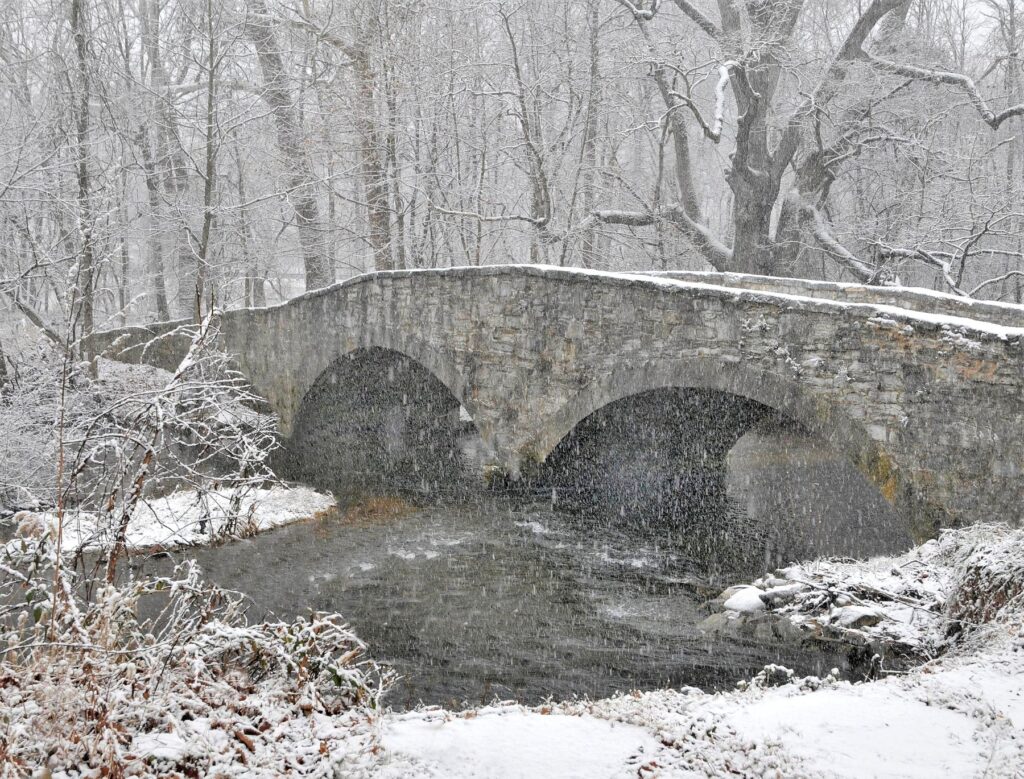
Over the years, one wish for many, both old and young, was the possibility of a White Christmas. Weather forecasting was less accurate in earlier times, and in 1912, a surprise snowstorm brought a foot of powdery precipitation. Many Boro residents were unprepared, and the newspaper said a “few Christmas trees left out in yards were covered thick with snow, and this made it very annoying for trimming when brought inside.”
An 1896 account of the first seasonal snow said it “came quietly, only a few scattered flakes here and there.” But the storm intensified, and the “feathery messengers of the clouds came faster, warming the expectations of those who love sleighing and wished for a White Christmas.”
Snow complicated travel to Grandma’s house during eras before modern transportation and snowplows. In the late 1890s, the Western Maryland Railroad offered special holiday excursion tickets to help customers arrive home safely for the holidays. That same year, the newspaper commended shoppers’ bravery after “a residue of ice and snow from a recent cold snap covered downtown sidewalks, making them exceedingly unsafe and slippy.”
A generation later, a heavy snowfall clogged Waynesboro’s town square, and the local trolley company helped remove a white mountain by hauling 15 carloads of snow outside the city limits.
Downtown Waynesboro merchants have come and gone throughout its history, but many names remain in memory as favorite places to shop or eat. Christmas presents have also changed. An 1899 advertisement for H.C. Criswell offered a variety of men’s “useful gift ideas,” including toilet slippers, walking sticks, linen handkerchiefs, and suspenders. A 1914 Christmas recap said Waynesboro merchants were “generally surprised by the volume of trade during the holidays.”
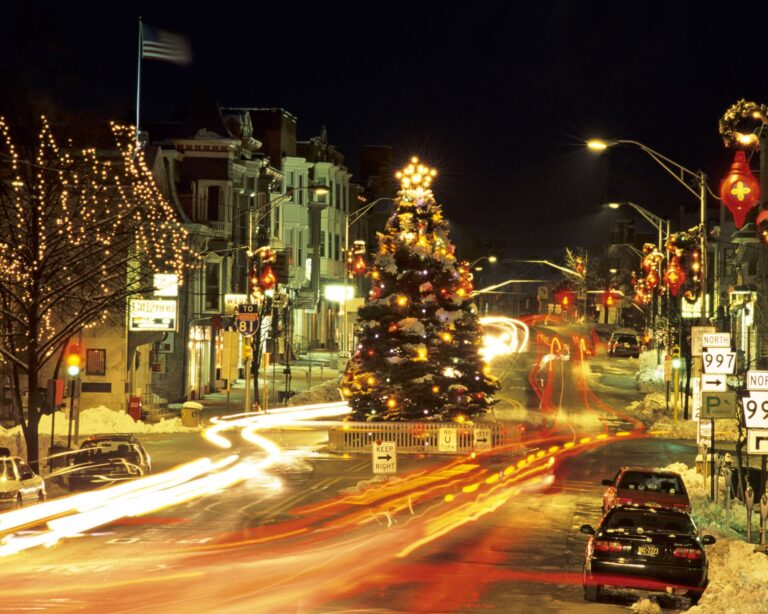
Many Waynesborians remember their favorite stores from childhood, now gone. Places like J.J. Newberry, McCrory’s, and J.C. Penney were anchor stores, while memories of other local merchants such as Minnich’s Drug Store, Joe the Motorist’s Friend, and the News Agency are preserved by old photographs or heard about from an elder’s recollection. In past years, the town’s Christmas tree was stationed prominently in the middle of the square, but now, for safety reasons, it is tucked into the diamond’s southwest corner.
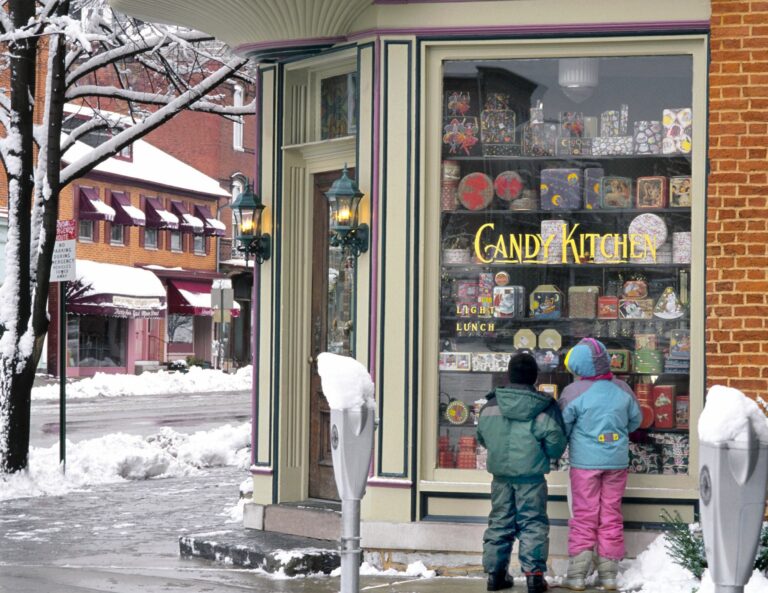
Fast forward to the latter 1900s, when malls and big-box stores siphoned off much of Waynesboro’s holiday gift-giving identity. Luckily, a modern generation of merchants now welcomes shoppers downtown. Except for James Shoes and the Candy Kitchen, most local stores are building new traditions and earning shoppers’ future holiday loyalty.
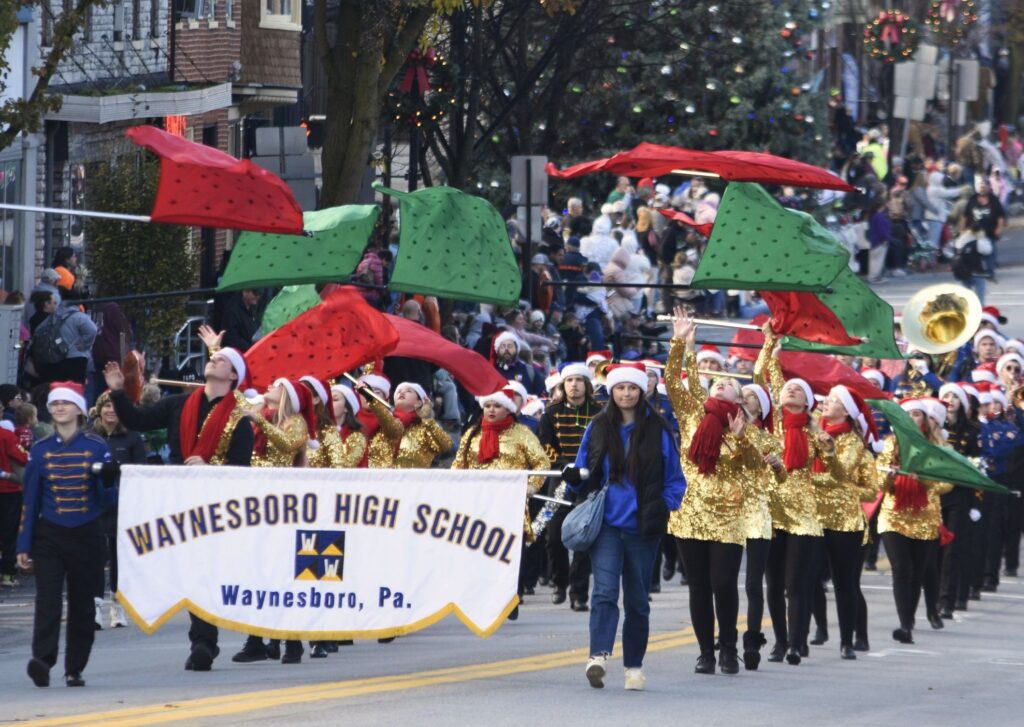
Christmas always brings festivities to Waynesboro’s downtown, with the most prominent events being the annual parades. In past eras, these festive marches have occurred on the actual holiday. An 1890s newspaper account described an Always There Hook and Ladder Company firemen’s parade and drill, conducted with full-dress uniforms, which took place on Christmas morning. Another interesting fact is that parades have traveled both west and east on Main Street through the years, although in recent decades, the latter has been the direction of choice.
Today, the firetrucks parading are candy-apple-red wonders of technology, and the antique cars cruising by are often the same vehicles residents rode in as children. During most modern parades, the live musical element and elaborate float décor have dwindled, only a shadow of their former glory.
These celebrations are scheduled earlier today, with the holiday parade and tree-lighting taking place before Thanksgiving. Modern generations have combined Thanksgiving, Christmas, and New Year’s Day into a six-week cluster of events, with more time for decoration, shopping, and childlike anticipation.
As each decade passed in the 1900s, Waynesboro residents lost sons in World Wars and braved the Great Depression. They did this while fighting to preserve local prosperity and keep treasured traditions alive. When the calendar turned over to all zeros in the new millennium, technology dramatically changed how we communicate, work, and play. However, Christmas has remained a constant celebration of faith and kinship between family and community.
Looking back in time, like a Dickens’ tale of Christmas past, we recognize lasting customs rest on a solid foundation. This sturdy structure is normally immune to fads or changing cultures. Christmas in Waynesboro melds many aspects of local history, along with respect for ancestry, into a season filled with faith, charity, and enduring traditions.