DAN DEATRICH BUILDS SHIPS THAT TRANSCEND TIME
By Robb Helfrick
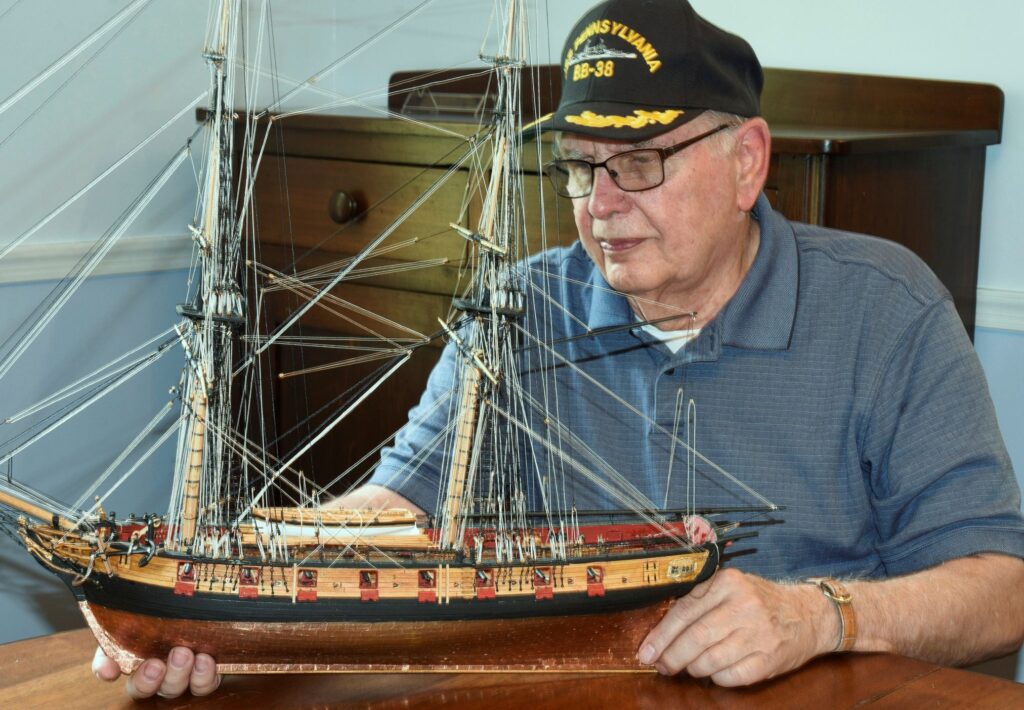
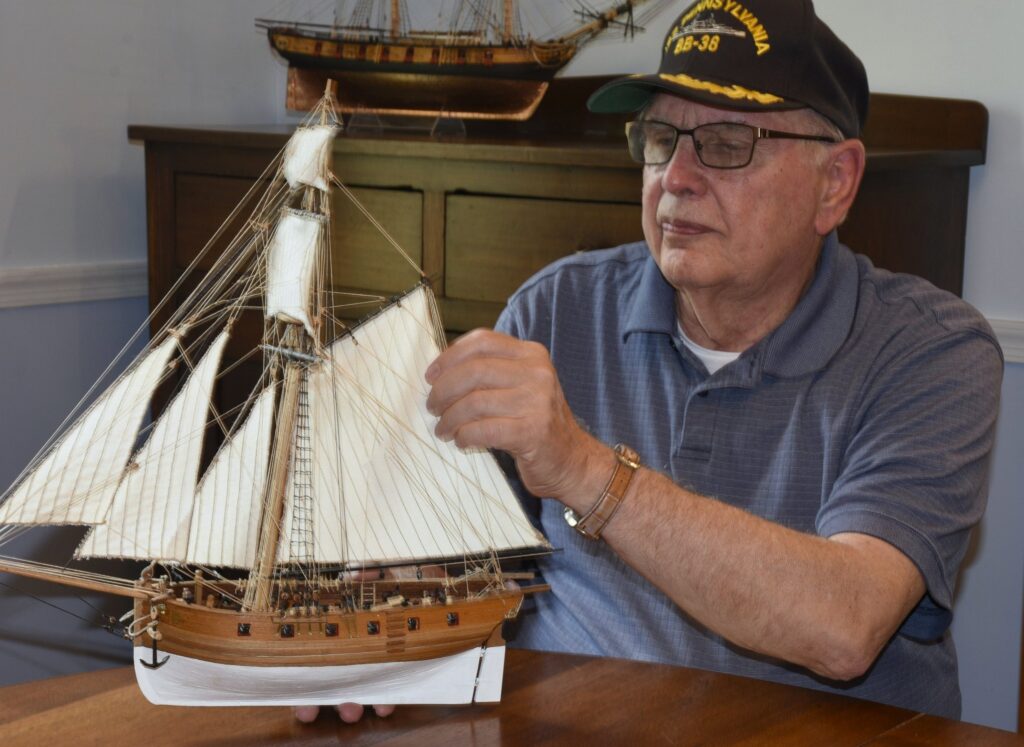
Dan Deatrich launched a model shipbuilding hobby that began over a half-century ago. When that journey started, he never envisioned creating a fleet of history’s most famous ships. Nor did he imagine one day tens of thousands of museum visitors would admire his handiwork. But after years of persistence, passion, and applying his talent, that is exactly what Deatrich achieved.
As a middle school student, Dan enjoyed his grandfather’s workshop. Through his elder’s example, Dan explored woodworking. “I was always tinkering,” he said. His interest in ships developed naturally, sparked by his imagination. “I liked the variety of ship designs, and how they evolved over time.”
Dan began with simple plastic models, but as his skills grew, he found himself working with more complicated wooden kits. Back then, the delicate pieces were cut by a jigsaw and were easily damaged by a neophyte’s hand. Dan learned one important lesson early on: “Building ships takes patience.”
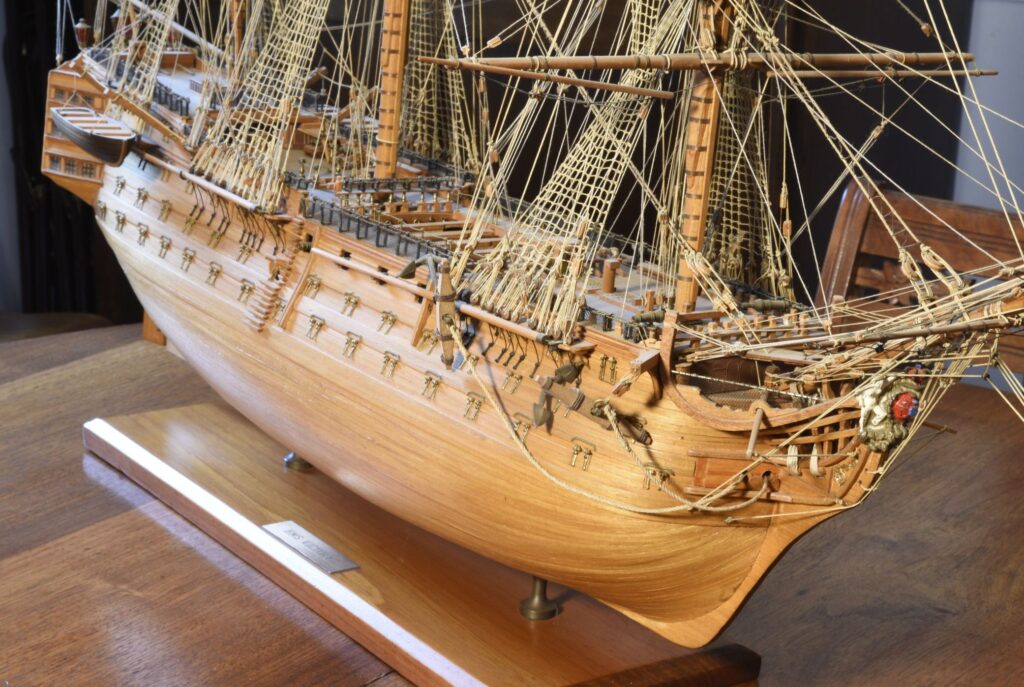
During the late 1970s, Deatrich began his most ambitious project to date. The HMS Victory was a storied ship, achieving its fame in the Royal Navy. The 104-gun British vessel was launched in 1765. The boat was known as the flagship of Lord Nelson, regarded as one of history’s greatest naval commanders. At the Battle of Trafalgar in 1805, Nelson was killed while on board the Victory. His last words: “For God and my country.”
Unlike Nelson, the Victory survived. It served active duty until 1824, and then later moved to drydock in Portsmouth, England. Today, HMS Victory is the world’s oldest naval vessel still in commission.
Deatrich’s timeless version shows the design of a First Rate warship, a Jacobean era designation reserved for the largest British ships, capable of carrying at least 400 men. An estimated 6000 trees were used to construct the Victory.
In Deatrich’s scale model, the walnut finish and intricate rigging bring the ship to life. Every fine detail of the original Victory is recreated, from giant windows at the stern to cannons pointing out the side. Having completed this ambitious project, Dan set his sights on America’s most celebrated ship.
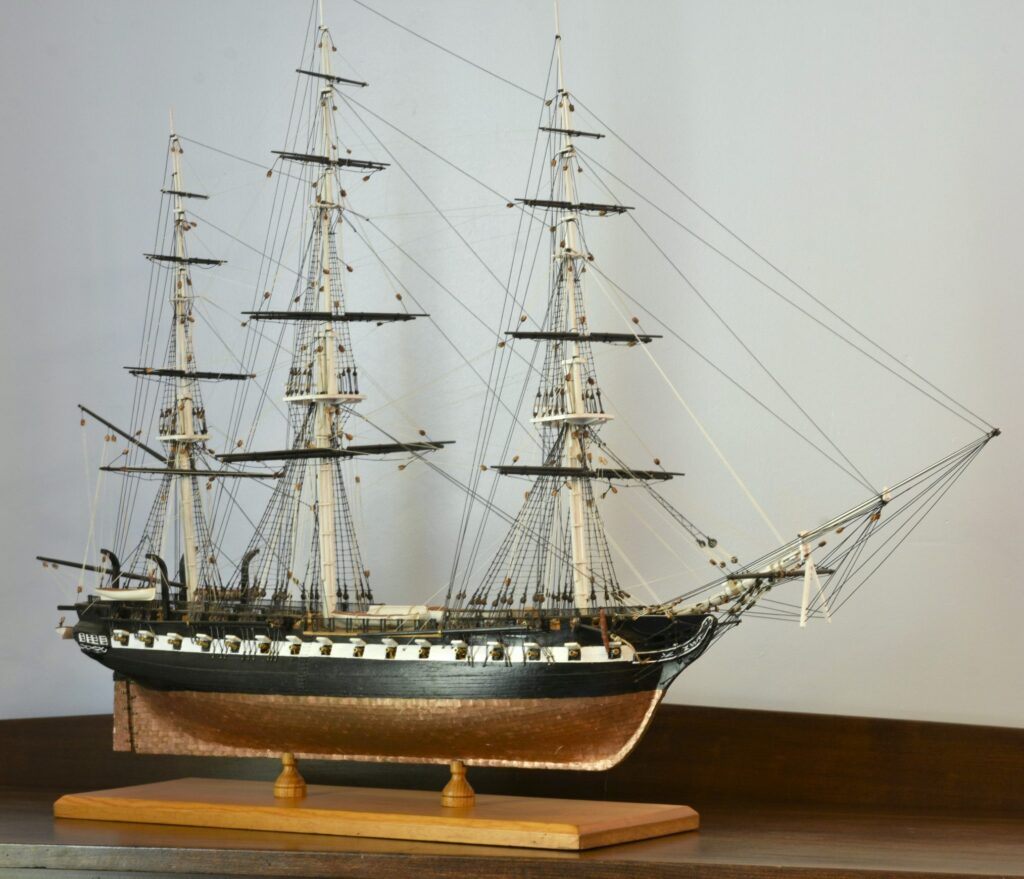
The USS Constitution was nicknamed “Old Ironsides” due to the wooden hull’s ability to withstand enemy cannonballs. She was built in Boston and launched in 1797. One of six original frigates authorized by the new United States government in 1794, the Constitution made its fame during the War of 1812, where she defeated five British warships.
The Constitution retired from active service in 1881 and was designated a museum ship in 1907. But the vessel stayed afloat. The Constitution completed a three-year, 90-port tour in 1934 and sailed in 1997 for its 200th birthday.
Today, the celebrated ship is back home in Boston, and a crew of 75 naval officers keeps her shipshape, and they lead year-round tours. The USS Constitution is the world’s oldest commissioned ship still afloat. “A trip to see her is on my bucket list,” Dan said with a smile. His regal model is a work of art; the copper-tinted hull contrasts beautifully with tall white masts.
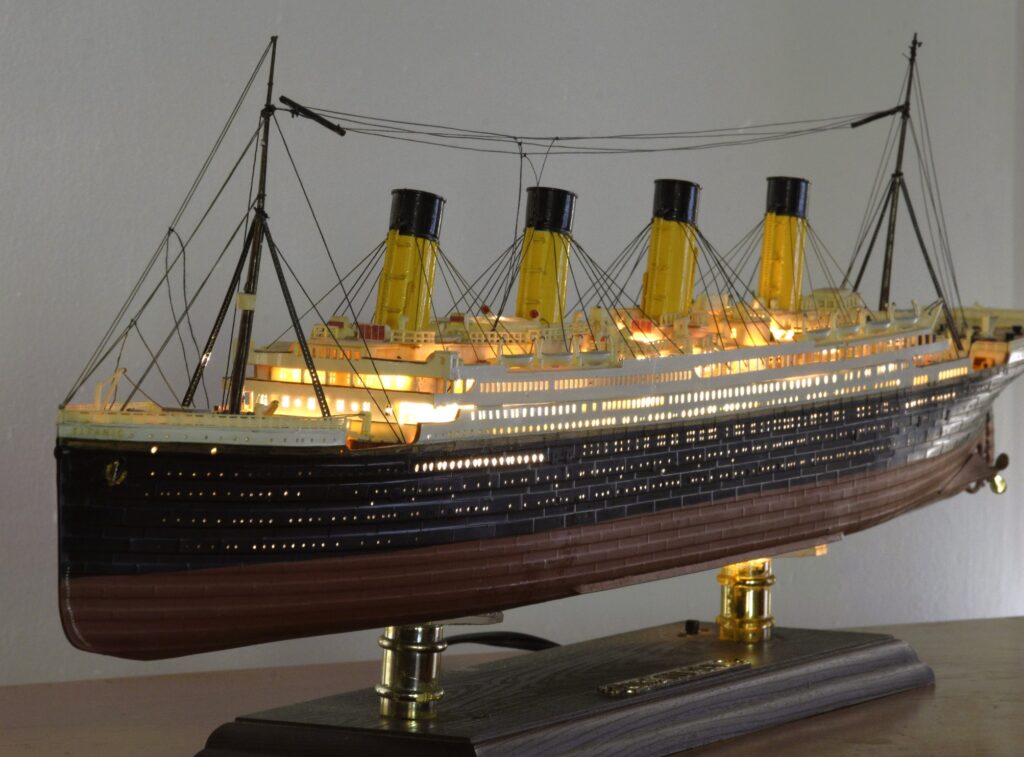
For Deatrich’s next journey, he went back across the ocean and into time, to a legendary voyage in 1912. Building on his previous achievements, he was drawn to the story of the RMS Titanic, a British passenger liner, the largest ship afloat at its time, and touted as being unsinkable.
The Titanic departed Southampton, England, in April 1912, carrying over 2200 passengers and crew, with a destination of New York City. But at night in the North Atlantic, the ship struck an iceberg and sank. More than 1500 people died, still the largest peacetime maritime disaster in history. For many years afterward, the wreck’s location was a mystery.
Explorers searched in vain to find the wreckage, but in 1985, an expedition led by Robert Ballard finally succeeded. A new wave of interest in the Titanic was sparked by this discovery, and Dan was inspired to create his own model.
By then, Deatrich’s skill and creativity had risen to a higher level. The only model available was plastic, but Dan had an idea. “I drilled holes in the ship and placed lights inside.” Dan’s Titanic model glows in the dark, recreating the doomed ship’s appearance before it slipped beneath the waves.
After those past successes, Dan was ready to tackle the biggest project of his shipbuilding career. Early on, he created only static models, ships that showcased his craftsmanship while simply displayed on a mantel or pedestal. It was time to put his models into the water.
Radio-controlled kits were available, and allowed a builder to also become the vessel’s captain. A new historical ship caught Deatrich’s eye. This one had ties to his native Pennsylvania and was active during his lifetime: the USS Pennsylvania.
The USS Pennsylvania (BB-38) was a battleship built for the United States Navy. Launched in 1915 and commissioned a year later, it was equipped with an oil-burning propulsion system and twelve 14-inch guns. Named for the Commonwealth of Pennsylvania, the ship did not take an active role in World War I, but escorted President Wilson to France during peace negotiations. During the 1920s, it was the Atlantic Fleet’s flagship, and later became part of the Battle Fleet.
The ship was present in Pearl Harbor on the fateful day of December 7, 1941. She suffered only minor damage, most likely saved by being in dry dock. The Japanese attack decimated the American fleet that day.
Later during World War II, the Pennsylvania was torpedoed at the Battle of Okinawa and suffered severe damage. She was withdrawn from service. The ship was repaired only enough to allow her to sail to the Bikini Atoll, where American nuclear tests were being conducted.
The Pennsylvania survived two intentional atomic bomb blasts, but the second explosion contaminated the vessel with radioactive fallout. Dan recalls the ship’s demise: “With that nuclear cargo, she was scuttled in deep water in 1948.”
To begin his version of the USS Pennsylvania, Deatrich could not rely on a pre-fabricated kit. He would build the ship from scratch. He went to the National Archives in Washington, DC, to study the ship’s original drawings. “I thoroughly enjoyed that research,” he said.
Deatrich began building the Pennsylvania around the year 2000. As he was still working full-time, progress was slow but steady. Over several years, he added extra detail to his model, including planes and a performing musical band on deck. As current Director of the Wayne Band (a group that has performed continuously for 126 years), that last touch was entirely fitting.
When completed, Dan’s USS Pennsylvania was six feet long, weighed fifty pounds, and was a one-of-a-kind monument to the Keystone State’s naval namesake. Then, Deatrich received a surprise call from the State Museum of Pennsylvania.
In 2016, the museum planned a 75th anniversary commemoration of Pearl Harbor. Would Deatrich lend his USS Pennsylvania model for that major exhibition? Dan was thrilled and initially loaned the ship for a four-year period. The reception for his model was overwhelming. Over 40,000 people gazed at his 1/8th scale model.
When he attended the opening reception, Dan was touched. “It was quite an honor to be part of it,” he said with typical modesty.
Later, the museum asked Dan to donate the Pennsylvania to their permanent collection. After retrieving the boat for a few last sails on Red Run Lake, Deatrich returned the ship to Harrisburg in November 2022.
Now, he keeps a project photo album, but his masterpiece belongs to the citizens of Pennsylvania. “I got a big kick out of people’s reaction to the Pennsylvania, especially the kids. Maybe one of them will take up the hobby and build the next generation of ships.”