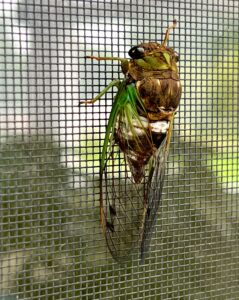
A Portrait of the Cicada
By Robb Helfrick
Editor’s note: A cicada portrait taken recently in Rouzerville by Sharon Munger inspired a closer look at the insect species.
Consider the cicada, creator of that familiar song of summer, but also an interesting insect that has inspired both memorable folklore and adventurous eating. When these creatures emerge from their subterranean lairs, they shed their skins, arrange liaisons in trees, and pack as much singing and mating as possible into a six-week life.
To begin, not all cicadas are alike. Over 3000 species exist, and they have different life cycles. These insects spend most of their lives underground as nymphs, with some broods having 13-year or 17-year life cycles. Other species arrive and depart in shorter timeframes.
Some cicada varieties appear every summer, since they are annual species. The famous periodic cicada (common to North America) called Brood X appears en masse every 17 years- the last occurrence was in 2021.
The great eastern brood of this type is the largest group, appearing in 15 U.S. states, including Pennsylvania and Maryland. In some locations, up to 1.5 million cicadas can occupy a single acre, so trillions of these insects can appear at once. But don’t fret; the next scheduled invasion isn’t until 2038.
Nymphs subsist underground for many years, munching on tree roots, but once they emerge to witness daylight, they have to act fast. The first chore is to shed their exoskeleton, a process that can take 5-6 hours. They leave behind crunchy shells stuck on trees and other surfaces, looking like the ghosts of insects past.
As males troll for females, they tune up for a high-decibel summer lovefest. Males don’t sing like crickets by rubbing their wings together; instead, they use a special organ called a tymbal that they flex to generate sound. Their abdomens are hollow, which may act as a resonating chamber.
And what a sound these male cicadas make- call levels have been measured up to 120 decibels, which is equivalent to attending a Metallica concert. A cicada heard at close range can actually cause hearing loss. However, some smaller species emit calls of such high frequencies that are inaudible to humans.
For some, the sound of distant cicadas is a soothing August soundtrack. Their songs can foster nostalgia for summers past. For others, cicadas are disruptive and annoying critters. The difference between viewpoints may depend on personal and cultural experiences. Fortunately, most male cicadas rest their tymbals at night after crooning all day.
What attracts females to a particular male? In a romantic insect world, she would be attracted by a suitor’s iridescent color or silvery wings, but in reality, the female is enthralled only by the male’s mating call. According to zoologists, she is drawn to a mate with a high-rate song with shorter sound intervals, which indicates a high-quality specimen.
In some situations, males will perform duets to drown out other competitors. Male cicadas can produce different pitches to call females, locate them, and then take romantic action. Before mating commences, females respond with a quick flick of their wings, like humans batting eyelashes. The male sees and hears this acceptance, and the two cicadas become an official couple.
After finding suitable mates, females lay 200-400 eggs. After hatching, they drop to the ground, then burrow to begin a new life cycle. Then, all the fun is over for the adult female cicada.
Above-ground cicadas aren’t gluttonous while seeking nutrition- most species feed on plant fluids by using their sucking mouthparts.
While cicadas can be noisy neighbors, they don’t bite or sting and are not poisonous. Despite having intimidating bug eyes and large wings, they are mostly harmless and can be beneficial to the environment.
How do cicadas contribute to an ecosystem? They are food for insect-eating animals (which can include humans, more on that later); they can aerate soil when they burrow underground; and cicadas can be a nitrogen source for trees.
Known for massive periodic 17-year swarms, cicadas are not locusts. The former are closely related to leafhoppers, while locusts are linked to the grasshopper family. Biblical plagues that destroyed large swaths of crops were the handiwork of locusts. Cicadas tend to be gentler to the landscape, although in periodic years they can damage trees and leaves with their sheer numbers.
The cicada holds a prominent place in human folklore and history. In some ancient cultures, the insect was a symbol of rebirth or immortality. Chinese civilizations used cicadas as a medicinal sedative, while other societies traded them as currency or valued them as an indicator species to predict the weather.
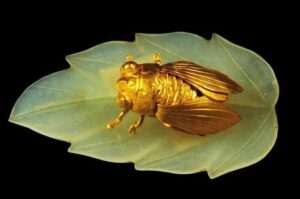
In literature, cicadas were mentioned in Homer’s Iliad and described by Aristotle in his History of Animals. In the creative world, cicadas were used as decorative art motifs in the Chinese Shang Dynasty. The New Zealand vocal artist Lorde featured cicada sounds prominently in her 2021 album Solar Power.
In gastronomic circles, the cicada has been a food source in many cultures, including ancient Greece. Modern diners in China, Africa, Malaysia, and Pakistan eat cicadas. Females are prized for being meatier.
Cicadas are considered a novelty food item in several U.S. states. Their taste is described by some as somewhat nutty and earthy, with a crunchy exterior and a creamy center. Other diners taste hints of asparagus, peanut butter, or shrimp. Common cooking techniques include stir-frying, sautéing, roasting, or deep-frying. The texture of an eaten cicada varies, depending on its developmental stage.
Thankfully, it isn’t necessary to dine on cicadas to appreciate their unique place in the animal kingdom. Their songs are ever-present in a northeastern summer, and their folklore dates back to the earliest recordings of human culture.
Cicadas expend a great amount of time and energy, waiting underground for only a few glorious days of mating and singing in the August sun. As summer nears its conclusion, these unique insects demonstrate the benefits of living in the moment during nature’s season of splendor.