FORT FREDERICK: THE HISTORY OF WESTERN MARYLAND WARFARE, PRESERVED IN STONE
Article and contemporary photographs by Robb Helfrick
For its first 150 years, Fort Frederick was a sleepy military and civilian outpost along the scenic Potomac River. This stone fort was built by British colonists, commissioned by Maryland’s colonial leadership in 1756. Perhaps because it was designed and built rock-solid- creating a powerful first impression to any who dare challenge it- Fort Frederick saw scarce action in American wars during the next century. But in recent years, the fort became a treasured architectural and cultural Maryland landmark.
The fort’s construction was overseen by Horatio Sharpe, Maryland’s colonial Governor. The design chosen conformed to a model favored by French military engineer Sebastien de Vauban, considered the father of fort architecture during that era. Vauban reportedly designed over 300 forts during his tenure under King Louis XIV. When completed, the Maryland structure was named in honor of Frederick Calvert, 5th Baron of Baltimore.
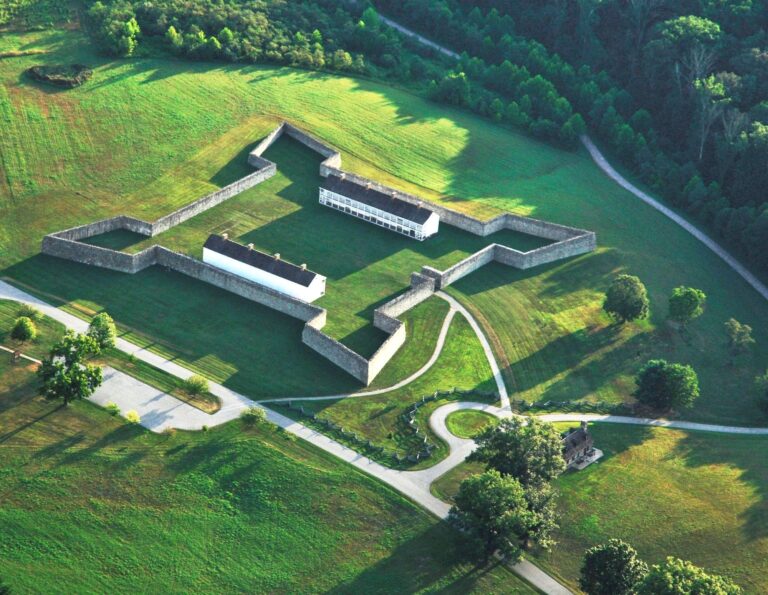
Fort Frederick is shaped as a large quadrangle with bastions at each corner. The walls between these four corners are 179 feet long and 17.5 feet high. The fort’s stone walls are three feet thick at their base. The four protective bastions project outward and are 4.5 feet thick. The fort’s main gate is positioned at the center of the south wall. At ground level, the structure is too large to grasp its massive scale. A modern-day aerial view clearly shows this French-inspired design.
A few years before the fort was completed, the French and Indian War erupted in North America. That war’s name (also called the Seven Years War in Europe) is misleading, since Native Americans fought on both sides of that conflict. Some natives aligned themselves with the British Crown, while other tribes sided with the French.
England and France had sparred continuously as imperial rivals around the globe, but in the mid-1700s, they argued over control of North America.
Any chance of a diplomatic solution ended when both sides sought control at the confluence of the Monongahela and Allegheny Rivers, at present-day Pittsburgh. In a military action that started the war, the Brits sent 22-year-old George Washington to western Pennsylvania to demand possession of Fort Duquesne. Washington never made it that far, defeated instead at Fort Necessity. For the moment, the French retained control over the three rivers region. Washington’s military glory would come later.
As war commenced, Britain held the advantage as their North American settlers outnumbered the French 20 to 1. Shorthanded, the French relied heavily on their Native American allies, which included the Algonquin, Ottawa, and Shawnee tribes.
Fort Frederick’s role in the French and Indian War was as a staging ground for troops and supplies. Maryland’s militia, who were British subjects, were stationed there, but they saw no action at the fort.
The war raged onward until 1763, and major battles were fought in the frontier regions from Virginia to Canada. When it finally ended, Britain’s superior numbers prevailed, and they seized most of France’s North American territory.
This victory carried a heavy economic toll. Britain doubled their national debt during the French and Indian War. Later, the country was forced to levy new taxes on the American colonies, a catalyst for future conflict.
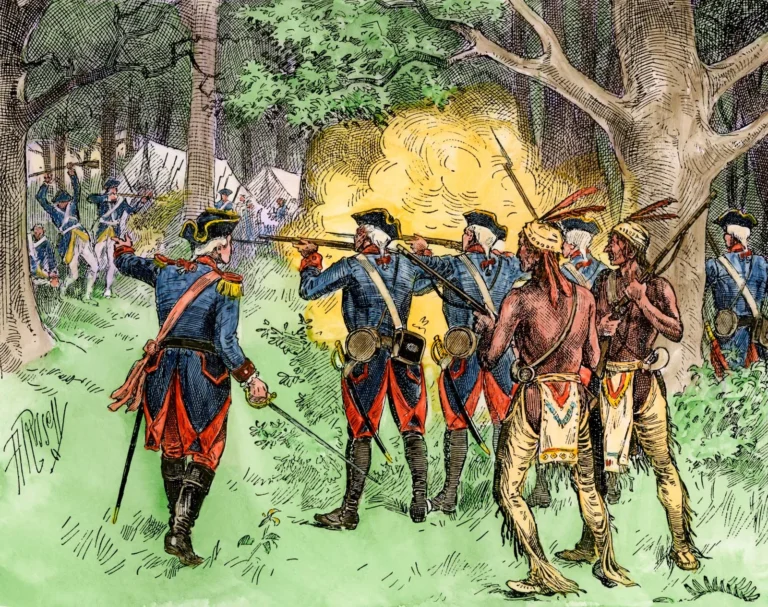
A generation later, when the Revolutionary War broke out, and General George Washington rose to fame, Fort Frederick again escaped the crosshairs of major battles. Instead, the fort served as a POW camp, used to hold 1000 British and German soldiers captured at far-flung battles in Saratoga, NY, and Yorktown, VA.
Following the American victory, Maryland became a U.S. State. The county that Fort Frederick occupied was eventually named for war hero and founding father George Washington. About the same time Washington took office as the first President, Fort Frederick was sold at auction. It appeared the fort had fulfilled its purpose and would fade into oblivion. The site was abandoned.
During the War of 1812, another Maryland fort stood at the forefront of the next British clash. Fort McHenry was originally a star-shaped earthen fort, later reinforced with brick and masonry. The fort’s site held extreme military importance- it protected Baltimore’s harbor.
A Frederick, Maryland, man named Francis Scott Key observed the fierce fighting at Fort McHenry in 1814. The battle inspired Key to write the Star Spangled Banner, America’s future National Anthem. American forces drove the British out of the United States’ territory for the final time. But no military action occurred at Fort Frederick.
Then, in 1861, Americans began a war amongst themselves. Maryland was a strategic buffer state between the North and the South during the Civil War. The C&O Canal and the B&O Railroad were important transportation enterprises located near Fort Frederick. The fort went back into commission.
But the fighting there was never as furious as it was at nearby Antietam or Gettysburg. On Christmas Day 1861, the Maryland Infantry protected Fort Frederick and fought a minor skirmish with Confederate raiders. The Union held the fort that day, and after 1862, Civil War armies fought elsewhere.
Soon afterward, a unique man bought the land and the fort. His name: Nathan Williams. Williams was a freed slave who had paid to free his future wife, Ammy. Nathan was known as a shrewd businessman, reportedly selling supplies to both Union and Confederate forces. However, he supposedly shared the southern information he collected with the Federal Army. After the war, the Williamses had four children and went to work.
The Williams family prospered at the former fort and gradually increased their land holdings. They farmed inside the fort’s walls- where they grew an orchard and penned their animals.
Maintaining the fort’s architecture was not a priority, nor financially feasible. When Williams’ heirs finally sold the property in 1911, the fort’s walls had mostly crumbled. Once again, it appeared the former defensive structure would fade into history.

Then, in 1922, the State of Maryland bought the fort along with the adjoining 500 acres. With foresight, they planned Maryland’s first State Park. Luckily, the fort’s original architectural plans were discovered. Practicing patient archaeology and utilizing dedicated resources, the fort’s walls were later reconstructed.
During the Great Depression, the Civilian Conservation Corps started a work camp and completed much of the fort’s restoration. The military structure was revitalized to resemble its original 1750s condition. That successful feat would later be recognized when Fort Frederick was designated a National Historic Landmark.
For modern-day visitors, Fort Frederick appears perfectly preserved. Its massive stone walls once again rise skyward to fend off imaginary invaders. Two of three original barracks have been restored- one to show how soldiers were garrisoned, another to exhibit and interpret artifacts relating to the fort’s history.
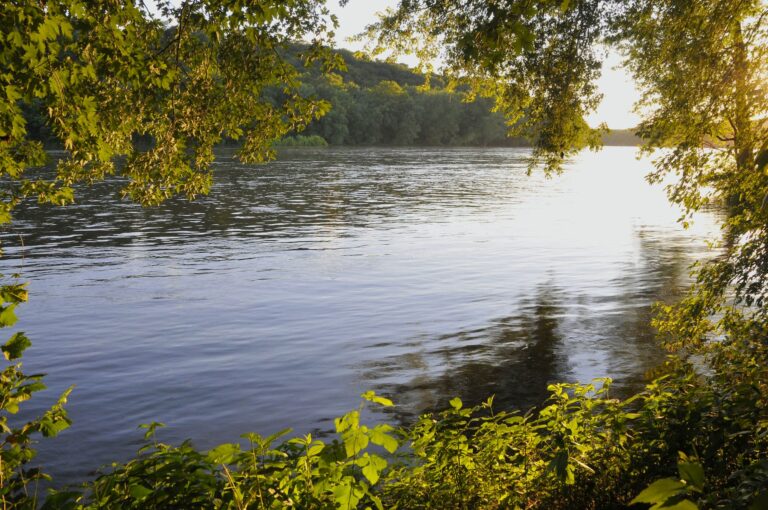
The surrounding landscape remains inspiring, nestled next to the mighty Potomac River. As a State Park, Fort Frederick’s 585-acre property has a multitude of natural recreational activities. Visitors can hike, camp, fish, boat, and picnic, in addition to experiencing American history. Nearby is the 23-mile Western Maryland Rail Trail.
Fort Frederick is located in Washington County, 18 miles west of Hagerstown and a mile south of Interstate 70 at Big Pool, Maryland. For Visitor Center hours, special events, and more information, contact the park at 301-842-2155 or learn more online: www.dnr.maryland.gov/publiclands. This ancient fort is also supported by a volunteer organization called Friends of Fort Frederick. This group sponsors educational and cultural activities throughout the year.
Fort Frederick is a lasting local artifact that encapsulates Maryland’s historic role on the early American frontier. Throughout its 270 years, the fort has witnessed a series of wars and the many cultural changes that influenced American society. While Fort Frederick did not host heroic last stands or see Francis Scott Key’s “rockets’ red glare,” its long history symbolizes the personal struggles and successes of ordinary Maryland citizens who waged daily wars to survive and thrive.