THE APPLACHIAN TRAIL: A HISTORY
Article and Photographs by Robb Helfrick
Along a legendary 2200-mile footpath that traces the rugged spine of an ancient mountain range, the Appalachian Trail passes through the local Southern Pennsylvania/Western Maryland region. This national treasure marks its halfway point in the area, as it meanders north toward Maine or travels south on its course to Georgia.
The Appalachians formed over one billion years ago. When long-ago continents violently collided, rocks were thrust upward, creating a major mountain range spreading from Canada to present-day Alabama. Appalachian summits once reached jagged heights comparable to the Swiss Alps. Millions of years later, natural erosion ground them down to their present rounded elevations.
At the turn of the 20th century, American civilization encroached on this vast wilderness. It was once suggested that a squirrel could travel by treetops along the entire Appalachian range and never touch the ground. However, by the early 1900s, logging, the Chestnut Blight, and rapid human development threatened that unique environment. Thankfully, the science of forestry developed during that same period, and wiser ecological planning soon commenced.

Benton MacKaye was the visionary who first suggested the idea for the Appalachian Trail. MacKaye was one of the nation’s first forestry professionals, born in 1879 and educated at Harvard. When MacKaye analyzed forest ecosystems in danger, he also foresaw negative impacts on human society. He believed that civilizations needed a buffer to protect nature from urban sprawl. In 1921, MacKaye published his theory in a work titled “An Appalachian Trail, a Project in Regional Planning”.
MacKaye’s idea created excitement, and his plan quickly gained momentum. The Appalachian Trail Conference was born in 1925, and work began on the ambitious trail, initially designed to link Mount Mitchell in North Carolina (the tallest peak in the Eastern U.S.) with Sugarloaf Mountain in Maine. While MacKaye was the dreamer behind the concept, the proposed A.T. also needed a doer to help complete the mammoth task.
That person was Myron Avery. He came into MacKaye’s orbit, and the two men collaborated for a time. Avery was also a Harvard graduate, but studied law. The two men’s contrasting styles and ideals created friction.
Avery was described as an intense man who enjoyed solving problems. He was always willing to compromise to accomplish big projects. By 1937, the original Appalachian Trail route was completed.
MacKaye’s heart stayed committed to the conservation movement, but he eventually split with the A.T. and Avery. Benton MacKaye later co-founded the Wilderness Society and remained a lifelong hiking advocate. He lived to age 96, and while he never hiked the entire pathway he inspired, MacKaye is still considered the father of the Appalachian Trail.
Myron Avery walked a different path. He personally blazed much of the original A.T. route (today marked with 2×6-inch white blazes) and was the first person to hike it end-to-end. Avery would repeat that accomplishment several times. His high energy and drive were legendary, and he served as the Potomac Appalachian Trail Club’s president. Avery then held the same title at the ATC until his death in 1952. Although he died young at age 52, Avery seemingly lived two lifetimes while conducting his tireless trailblazing work.

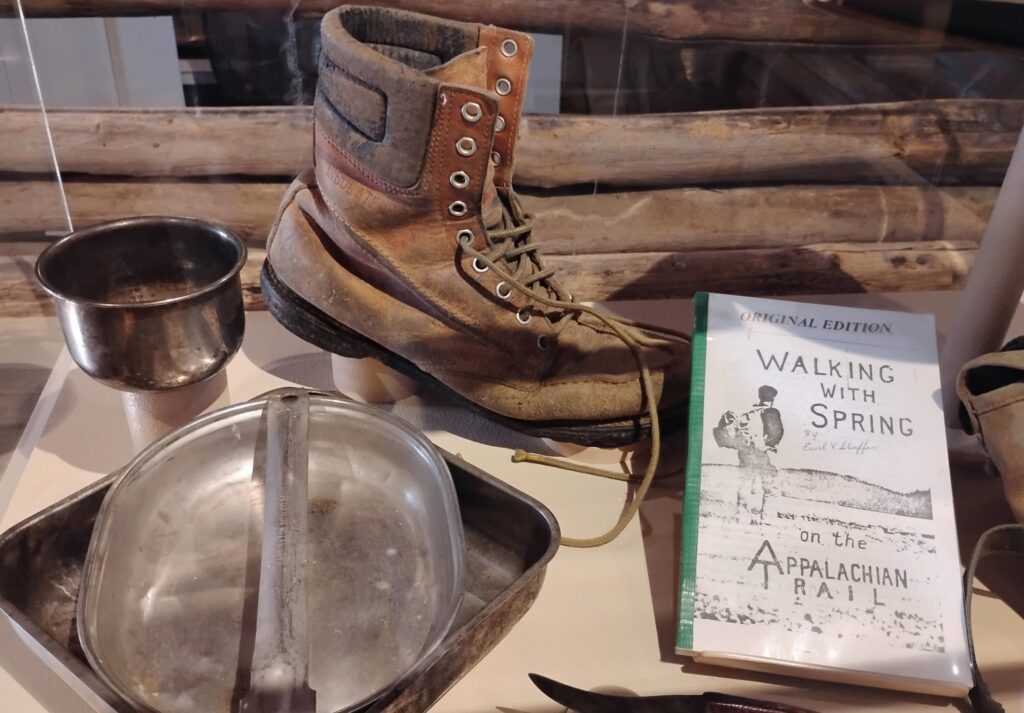
In A.T.’s early history, hikers relied solely on guile and instinct. Long before modern communications, lightweight equipment, or waterproof clothing, they carried only basic gear. During those first decades, traditions developed that endure to the present day.
The ultimate goal in those early years was to walk the A.T. in a single multi-month one-way hike. Called “thru-hikers,” these folks typically started at the Georgia southern terminus in early spring, hiked north following warmer weather, and finished in Maine by autumn.
Thru-hikers also adopted trail-name pseudonyms while signing a series of log books along their A.T. hike. Constant communication with fellow hikers was essential. Thru-hikers relied heavily on each other. Resupply drops were shipped from home and needed to be picked up at trailside post offices. The entire A.T. trip required 5 million steps, and little support came from the outside world.
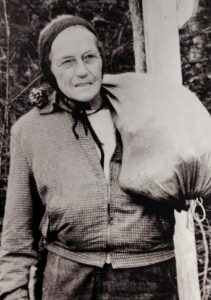
National Geographic ran an Appalachian Trail feature in the late 1940s, and a unique woman from Ohio read it. The story inspired her. Her name: Emma “Grandma” Gatewood, a mother of 11 children. In 1955, after she raised her brood, Emma decided she’d go for a hike. She rode a bus to Georgia and began her solitary journey with a shower curtain for shelter, a pair of Keds on her feet, and supplies stuffed in a homemade denim bag.
After 146 days on foot, Gatewood reached the A.T.’s northern terminus at Maine’s Mt. Katahdin. At age 67, with boundless energy, Grandma Gatewood was the first solo woman to hike the Appalachian Trail. She would repeat that feat twice more, in 1957 and again in 1964, at age 76. She was the first and oldest woman to complete the A.T. three times. A hiking legend was born.
As the Appalachian Trail’s popularity grew, so did the responsibilities to maintain it. The trail’s total distance changes yearly, and in 2025, it totals 2197.4 miles. Natural issues such as erosion and flooding require constant minor route revisions to provide the safest hiking experience. A series of 31 clubs maintains the A.T.’s entire route, forming a partnership that has ensured its long-term vitality.
The Potomac Appalachian Trail Club maintains the pathway in Franklin County, PA, and Washington County, MD. The PATC manages 240 miles of the A.T. (along with 650 miles of other trails) and 45 shelters. These responsibilities require an estimated 90,000 work hours each year. Local A.T. sections would be unsustainable without the diligent volunteer efforts of PATC’s 8,000 members.
Back in 1968, Congress enacted the National Trail Systems Act. This facilitated the future protection of the A.T. corridor. The modern Appalachian National Scenic Trail traverses 41 miles in Maryland and 230 miles in Pennsylvania, 11% of its total length. Today, 99% of the A.T. 14-state property is now owned and preserved by the National Park System.
Contemporary hikers have adopted ingenious practices to enjoy the A.T. in new ways. While thru-hiking remains popular, many other enthusiasts have completed the entire trail in multiple individual hikes spread over many years. Called “section-hikers,” they accomplish this within personal boundaries. Hikes are tailored in length and direction, based on a person’s fitness level, trail difficulty, or seasonal weather conditions.
Other hikers “flip-flop” by starting at local spots such as Harpers Ferry. They walk south and then later return to hike northward toward Maine.
Peggy Weller is a local section-hiker who completed the Appalachian Trail. Weller, a retired teacher at PSU Mont Alto, yearned to test her capabilities. She said the hardest sections of the A.T. were an “exquisite obstacle course”, but over five years, she chipped away at the A.T. trail sections.
Finally, Weller, who gave herself the trail-name Nanny Goat, finished her quest in 2016. “The trail teaches you’re much more resilient than you think you are.” When she completed the journey, Weller was 68 years young. Today at 77, she still walks regularly and organizes a hiking group.
On Earth Day 2014, Waynesboro became an official Appalachian Trail Community. This distinction is earned by a formalized commitment to help passing hikers. Often, local A.T. Community organizers give free rides to local grocery stores or hotels. Some even bring thru-hikers home and provide a hot shower, hearty meal, or access to a washer/dryer. This extra kindness from strangers is known throughout the hiking community as “trail magic,” which often materializes when a hiker needs it most.
For outdoor enthusiasts, the Appalachian Trail is a pathway to solitude or a scenic avenue to reconnect with nature. Fortunately, many accessible A.T. trailheads are found locally. The trail is open to hikers of all ages and abilities, regardless of whether the goal is five million steps or five thousand. Over three million people enjoy the A.T. every year.
During autumn, a profusion of leaf colors is found along the Appalachian Trail as trees prepare for winter dormancy. At overlooks, a tapestry of red and orange hues is evident on the undulating ridges of the Appalachians.
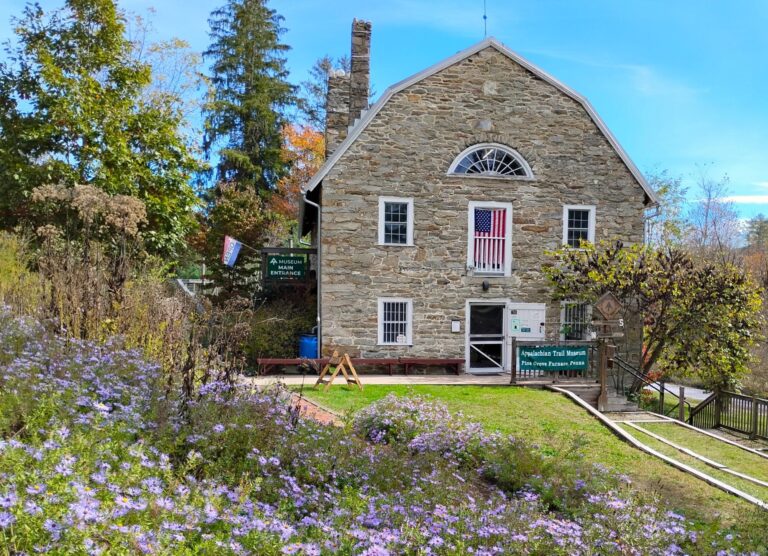
To learn more about the A.T., visit the Appalachian Trail Conservancy website: appalachiantrail.org. The Appalachian Trail Museum in nearby Pine Grove Furnace celebrates the A.T.’s rich history in a rustic rock barn (atmuseum.org). Every year, a new class is inducted into the A.T. Hall of Fame.